
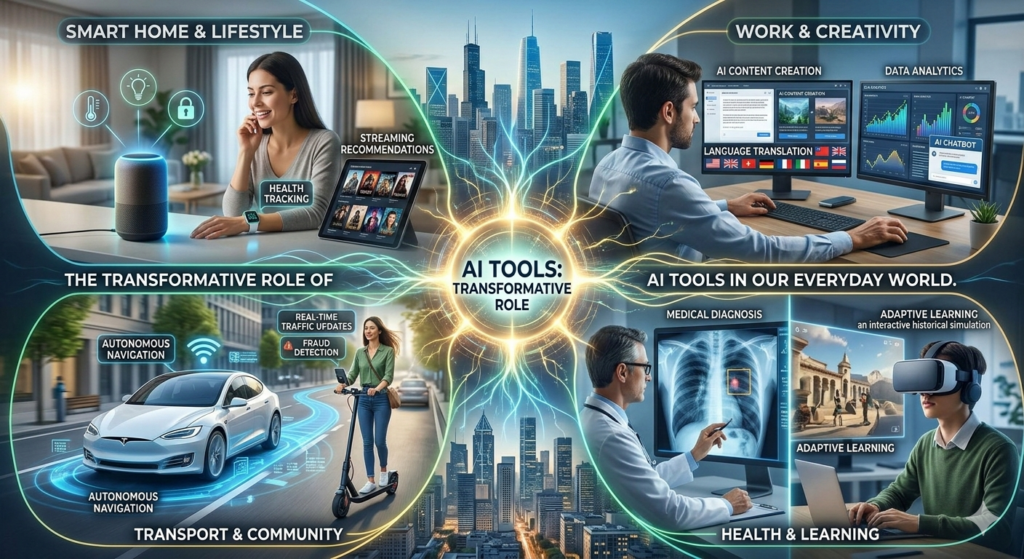
Hey there, fellow tech enthusiasts and curious minds! Have you ever paused mid-task, wondering how a simple app on your phone just saved you hours of hassle? That’s the magic of AI tools sneaking into our lives, quietly revolutionizing how we work, create, and even heal. In this post, we’re exploring the real impact of AI tools—moving beyond the buzz to uncover the practical, everyday ways they’re changing how we live, work, and create in 2026. From boosting productivity to sparking creativity and supporting health, this is the transformative role of AI tools in our everyday world in action. AI tools in everyday life are transforming how people work, communicate, learn, and solve problems.
The Role of AI tools in our everyday world it rapidly transforming how people interact with technology. From smart assistants and recommendation systems to healthcare diagnostics and automated business processes, improve efficiency and productivity. As technology advances, the use of AI tools in everyday life will continue to grow, making daily activities easier and more intelligent.
From boosting your daily grind to sparking artistic breakthroughs, AI isn’t some distant sci-fi dream; it’s here, making things simpler and smarter. Buckle up as we explore this exciting landscape with fresh insights and stories that feel like a chat over coffee.
What Exactly Are AI Tools? A Quick, No-Jargon Breakdown
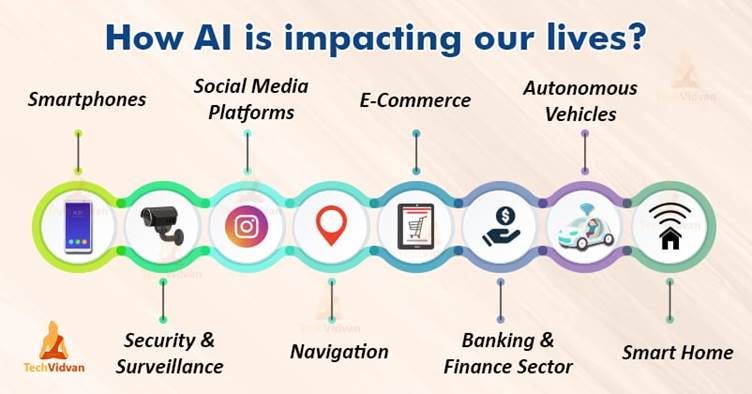
Let’s start at the basics because, honestly, AI can sound intimidating—like it’s plotting world domination from a server farm somewhere. But strip away the buzzwords, and AI tools are just smart software that learns from data to help us do things faster and better. Think of them as super-powered assistants: they analyze patterns, predict outcomes, and automate the boring stuff.
At their core, AI tools use machine learning (a subset of AI) to “train” on massive datasets. For example, your Netflix recommendation engine? That’s AI crunching your viewing history to suggest that next binge-worthy series. Or Siri handling your voice commands without missing a beat. These aren’t one-off gadgets; they’re woven into apps like Grammarly for writing, Canva’s Magic Studio for design, or even Google Maps for traffic predictions.
The beauty? They’re accessible. You don’t need a PhD to use them—free tiers on tools like ChatGPT let anyone generate ideas or draft emails in seconds. But their role goes beyond convenience; they’re amplifiers for human potential. In a world drowning in information overload, AI tools act as filters, turning chaos into clarity. And as we’ll see, their impact spans industries, promising a future where creativity and efficiency aren’t at odds.
Supercharging Productivity: How AI Tools Are Your New Work Bestie
It’s Monday morning, your inbox is a battlefield, and deadlines loom like storm clouds. Enter AI tools, swooping in to reclaim your time and sanity. Their role in productivity isn’t just about speed—it’s about freeing your brain for the big-picture thinking that truly matters.
Take writing business documents, a task that used to eat up hours. Recent studies show AI can slash that time dramatically. For instance, workers using generative AI reported saving about 5.4% of their work hours weekly, translating to a modest but meaningful 1.1% overall productivity bump. Zoom out, and the numbers get exciting: AI delivers 14-55% gains at the task level, especially in repetitive jobs like data entry or customer queries. In software engineering, early adopters are seeing 20-45% efficiency jumps, while customer support teams clock 30-45% improvements.
Why does this happen? AI handles the grunt work. Tools like Notion AI summarize meetings, while Otter.ai transcribes calls with eerie accuracy. In marketing, Jasper or Copy.ai churn out ad copy variations in minutes, letting teams focus on strategy. But here’s the real story: it’s not replacing jobs; it’s elevating them. A Nielsen Norman Group study found programmers using AI completed tasks 55% faster without sacrificing quality. (Okay, full disclosure: not every company’s feeling the love yet—over 80% report no broad gains, often due to integration hiccups. But for those who nail it, it’s a game-changer.)
I remember chatting with a freelance graphic designer friend who swore by Adobe Sensei—it auto-suggests layouts, cutting her project time from days to hours. The result? More clients, less burnout. Looking ahead, experts predict AI could boost global productivity by 1.5% by 2035, snowballing to 3.7% by 2075. That’s not just numbers; it’s more time for family, hobbies, or that side hustle you’ve been dreaming about.
Igniting Creativity: AI as the Ultimate Muse for Artists and Innovators
If productivity is AI’s left brain, creativity is its wild, right-brained soul. Far from stifling imagination, AI tools are unlocking doors we didn’t know existed, turning “what if” into “watch this.” In creative industries, their role is collaborator, not competitor—sparking ideas and handling the tedious bits so humans can dream bigger.
Consider music: Tools like Musicfy or MuseNet let composers generate melodies from a hummed tune, blending genres in ways that’d take humans weeks. One indie artist I follow used it to layer electronic beats over folk lyrics, landing a viral track on Spotify. Or visual arts: Midjourney and DALL·E conjure stunning images from text prompts like “a cyberpunk city at dawn with floating lanterns.” It’s not cheating; it’s inspiration on steroids. Platforms like Runway take it further, editing videos with AI-driven effects that once required Hollywood budgets.
Writing? Oh boy, that’s where the fun ramps up. Jasper and Copy.ai aren’t just spell-checkers; they brainstorm plot twists or refine prose, helping authors overcome blocks. In advertising, agencies use VEO for hyper-realistic video prototypes, slashing production costs. A Forbes piece highlighted how these tools transformed a small agency’s campaign, boosting engagement by 40% through AI-generated storyboards.
But let’s get personal. As someone who’s dabbled in blogging, I’ve used ChatGPT to outline posts— it suggests angles I hadn’t considered, like weaving in user stories for relatability. The key? AI excels at quantity; humans bring the soul. Tools like ElevenLabs add voiceovers with emotional nuance, making podcasts feel alive. And in fashion, AI simulates fabric drapes, letting designers iterate virtually.
Of course, it’s not all rainbows. Ethical debates swirl around ownership—who owns AI-generated art? Yet, the consensus from creative pros is clear: these tools amplify, they don’t replace. As one World Economic Forum report noted, generative AI like Claude.ai is reshaping industries by democratizing access, letting hobbyists compete with pros. In essence, AI’s role here is to lower barriers, fostering a renaissance where ideas flow freer than ever.
Healing the World: AI Tools’ Lifesaving Role in Healthcare
Now, shift gears to something profoundly human: health. Here, AI tools aren’t luxuries—they’re lifelines, diagnosing diseases faster and personalizing care in ways that save lives. Their role? Bridging gaps between vast data and human expertise, especially in overburdened systems.
Flash to 2023: AI adoption in healthcare was already surging, but 2024 flipped the script. Nearly two-thirds of physicians (66%) now use AI, a whopping 78% jump from the prior year. Hospitals? 71% integrate predictive AI with electronic records, up from 66%. Why the boom? Tools like IBM Watson spot cancer in scans with 95% accuracy, often catching what tired eyes miss. In radiology, AI flags anomalies in X-rays, reducing wait times from weeks to days.
Personalized medicine is another star. AI analyzes genomes to tailor treatments—think predicting drug responses before you pop a pill. During the pandemic, algorithms forecasted outbreaks, guiding resource allocation. A McKinsey report on generative AI notes it’s streamlining admin tasks, freeing docs for patient chats.
Real-world wins? In rural clinics, AI chatbots triage symptoms, connecting folks to care remotely. Domain-specific tools have hit 22% adoption in orgs—a 7x leap since 2024. Challenges persist, like data privacy (hello, HIPAA compliance), and only 19% report full success in imaging. Still, the trajectory is hopeful: AI could cut diagnostic errors by 30%, per experts.
Imagine a world where your smartwatch AI detects heart irregularities early, or apps simulate surgeries for training. That’s not tomorrow—it’s now, quietly saving lives one algorithm at a time.

Navigating the Road Ahead: Challenges, Ethics, and the Bright Future of AI
No rose-tinted story is complete without thorns. AI tools’ role is transformative, but not flawless. Privacy concerns loom large—how do we trust systems with our data? Bias in algorithms (trained on skewed info) can perpetuate inequalities, like misdiagnosing skin conditions in diverse tones. Job displacement fears? Valid, though history shows tech creates more roles than it erases.
Regulation lags, too. The EU’s AI Act is a start, classifying tools by risk. Ethically, in creativity, watermarking AI art fights plagiarism. Yet, the upside dazzles: by 2055, AI could hike GDP by nearly 3% through smarter everything.
Peering forward, expect multimodal AI blending text, image, and voice for seamless experiences. In education, personalized tutors; in climate, predictive modeling for disasters. Tools like Grok (shoutout to xAI) push boundaries with witty, helpful interactions. The role evolves from helper to partner, but humans steer the ship—our values, our choices.
Wrapping It Up: Embrace the AI Wave with Open Arms
So, what’s the takeaway from our whirlwind tour? AI tools aren’t just gadgets; they’re catalysts, enhancing productivity, fueling creativity, mending health, and charting futures. They’re simple to start—pick one tool today, like a free AI writer or image generator—and watch the shift.
The world’s changing, but it’s our story to tell. Dive in, experiment, and let’s build a tomorrow that’s smarter, kinder, and wildly imaginative. What’s your first AI adventure? Drop a comment below—I’d love to hear!
The transformative role of AI tools in our everyday world is real and accelerating—boosting efficiency, unlocking creativity, improving health, and connecting us better. Start simple: pick one free tool (ChatGPT, Grok, Gemini) and experiment.